Navigating Digital Authorship in the European Landscape
The rapid evolution of generative tools has blurred the lines between human intent and automated output, leaving many creators questioning their legal standing. This guide explores the specific hurdles of protecting digital-native works and navigating the complexities of how to copyright digital art in Europe effectively.
Defining Originality in Digital Mediums
Protecting a digital asset requires understanding the legal threshold of originality and the precise human contributions that EU courts recognize. We will examine the boundaries of human creativity and the necessity of documenting your unique process.
The Threshold of Human Creativity

In the European Union, the legal protection of a digital work hinges on the concept of the “author’s own intellectual creation.” This means that for a piece to be eligible for copyright, it must reflect the personality of the creator through free and creative choices. When you are determining how to copyright your digital art in Europe, you must look beyond the final pixels and identify the specific aesthetic decisions—such as lighting, composition, and the intentional manipulation of software—that distinguish your work from a generic, tool-generated output.
The distinction between a copyrightable work and an unprotectable digital file often lies in the level of human intervention. While standard automated filters or basic software functions do not meet the threshold of originality, transformative choices do. For example, protecting your designs from copycats on Instagram requires demonstrating that the visual identity was a result of your personal creative path rather than a byproduct of the software’s default settings.
| Activity Type | Standard Digital Edits (Not Copyrightable) | Transformative Artistic Choices (Copyrightable) |
|---|---|---|
| Software Interaction | Applying a pre-set automated filter or using a single-click AI prompt without further manual refinement. | Manual layer blending, custom brushwork, and the specific arrangement of elements to convey a unique message. |
| Visual Composition | Using stock templates or software-suggested layouts with minimal adjustments. | Deliberate selection of color palettes, perspective, and lighting to reflect a specific artistic vision. |
| Output Control | Relying on the software to determine the final aesthetic result. | Iterative refinement where the creator dictates the final look through precise technical and creative adjustments. |
While copyright arises automatically upon creation to protect the expression of your work, please note that it does not cover brand names or logos; these may require separate trademark registration to secure commercial identity.
Proving these creative choices in a legal dispute becomes significantly easier when you have a clear record of how your vision evolved from a concept to a finished file.
Documenting Your Creative Process
Establishing a robust threshold of human creativity is the first step, but the legal weight of your work ultimately rests on your ability to prove exactly when and how that work came into existence. In the digital realm, where files can be manipulated or backdated with ease, maintaining a meticulous creative log is not just a habit for the organized; it is a critical defensive measure under European intellectual property standards.
Courts and the European IP Helpdesk emphasize that while copyright arises automatically, the burden of proof in an infringement claim lies with the creator. To successfully demonstrate how to copyright digital art in Europe effectively, you must move beyond the final export and preserve the narrative of your artistic evolution. A simple “Date Modified” timestamp on a folder is rarely sufficient to deter a sophisticated infringer or satisfy a judge during a dispute over eu copyright laws for freelance creators.
A professional proof-of-creation log should include the following technical and creative milestones:
- Conceptual Sketches and Metadata: Retain initial low-fidelity drafts, wireframes, or rough brushwork layers. Ensure your software’s metadata (EXIF or XMP data) remains intact, as it records the original creation date and the hardware/software environment used.
- Version History Documentation: Save incremental versions of your project files (e.g., v01, v02, v05) rather than overwriting a single master file. This sequence demonstrates the “intellectual creation” process that European law requires for eligibility.
- Third-Party Timestamper Usage: Utilize qualified electronic timestamps or blockchain-based registration services that comply with EU eIDAS regulations. These provide an immutable record that the specific file existed at a specific point in time, which is far more persuasive than a local file system record.
- Communication Records: Keep logs of emails with clients or collaborators where drafts were shared. These external records serve as secondary evidence that the work was in your possession and under your control on a certain date.
This technical paper trail bridges the gap between a conceptual idea and a legally defensible asset. However, even the most perfect documentation cannot fully insulate a creator from the external threats inherent in an interconnected market, where borderless infringement presents entirely new hurdles.
Related topic reference: How to copyright digital art in Europe effectively.
Modern Hurdles for Digital Creators
Beyond establishing authorship, digital artists face external threats like unauthorized scraping and restrictive platform terms. We will now examine the complexities of cross-border piracy and how statutory rights interact with service agreements.
Challenges of Borderless Digital Piracy

The digital landscape has dismantled geographical barriers for creators, but it has simultaneously decentralized the mechanics of infringement, creating a reality where a design uploaded in one EU member state can be illicitly commercialized across the entire Single Market within minutes. Navigating these modern hurdles requires a shift from reactive complaints to a proactive legal strategy that accounts for the fragmented nature of enforcement across different jurisdictions.
Enforcement across EU borders remains complex. While the Berne Convention provides a harmonized copyright baseline, stopping a copycat often involves navigating distinct national court systems and procedural rules. For instance, while a platform-based notice might remove a post on Instagram, it does nothing to stop the sale of physical merchandise on a local third-party marketplace. Without formal evidence of ownership, such as a verifiable chain of title, pursuing a cross-border injunction is often resource-intensive and legally precarious.
Warning: The Platform Tool Trap
Do not rely solely on automated platform-provided copyright tools as your primary legal shield. These internal systems (e.g., standard social media reporting mechanisms) are private contractual tools designed to manage platform liability under the Digital Services Act (DSA), not to provide statutory legal remedies. They lack formal “legal teeth”; a platform’s decision to remove content is not a judicial finding of infringement and does not grant the right to damages or a permanent, court-ordered injunction against a repeat infringer.
To effectively combat borderless piracy, creators must look beyond basic content-removal requests. Professional enforcement often necessitates documenting a clear chain of title and, where applicable, utilizing formal legal proceedings to secure cross-border remedies beyond the reach of platform moderation.
Strategic Enforcement Comparison
Consider the distinction between administrative moderation and formal litigation:
- Platform Reporting: High speed, limited to platform-internal content removal, easily contested by counter-notices, and yields no financial recovery.
- Statutory Litigation: High complexity, results in legally binding court orders, enables claims for damages, and allows for seizure of infringing goods across the Single Market.
Platform Terms vs Statutory Rights
While borderless piracy presents external threats, the relationship between a creator and a hosting platform often creates a deeper risk to digital authorship. Many artists assume that prominent portfolio sites or social networks automatically protect their statutory rights, but Terms of Service (ToS) function as private contracts that can override these protections. In the European legal framework, moral rights—such as the right to be identified as the author—are generally inalienable, yet by accepting a platform’s terms, you may unintentionally grant a worldwide, sub-licensable license for your work. This creates tension when platforms modify, crop, or overlay branding on your creations, potentially infringing on your right to the integrity of the work under EU copyright directives.
Platform agreements are particularly contentious regarding non-human generated content, as many ToS now include clauses permitting the use of uploaded assets for training generative AI models. Unlike copyright, which protects your creative expression and is granted automatically upon creation, these platform-specific licenses can significantly diminish your control over how your work is utilized by the host or third-party AI developers.
- Sublicensing: Determine if the platform can sell or distribute your work to third parties.
- Moral Rights: Identify clauses requiring you to “waive” or “not assert” rights, which can weaken your position in infringement disputes.
- Data Retention: Verify if the license to your content survives after you delete your account or archived files.
- AI Training: Explicitly check for terms that allow the platform to utilize your uploaded files for training machine learning models.
- Jurisdiction: Note if the ToS mandates arbitration in a non-EU country, which can make exercising your statutory rights financially impractical.
Practical Evidence Preservation Techniques
Securing your creative legacy requires shifting from passive reliance on platform terms to proactive defense. We now examine technical methods for verifying authorship through immutable time-stamping and strategic asset management.
Time-stamping and Blockchain Verification
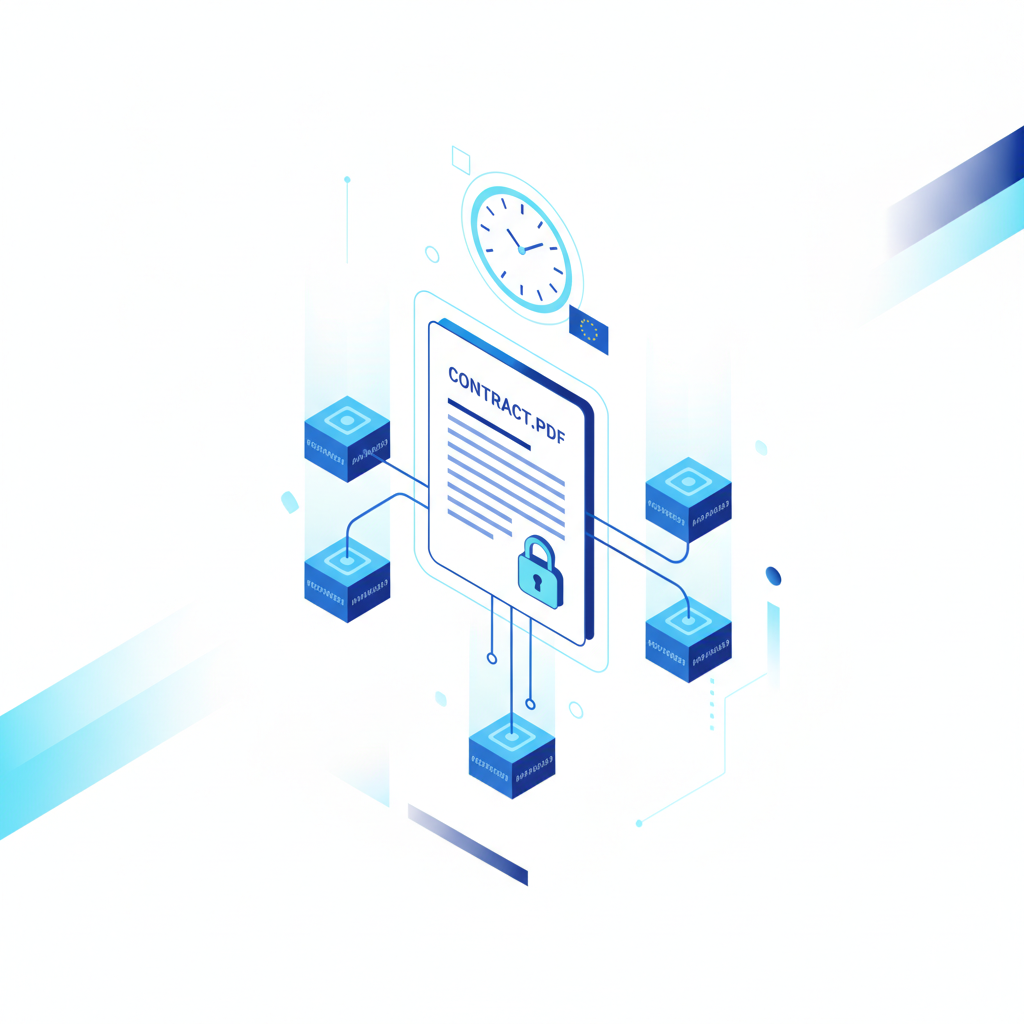
Establishing a definitive timeline is the cornerstone of any successful infringement claim in the European Union, where the burden of proof rests entirely on the author. Because standard operating system metadata can be easily manipulated, professional creators are increasingly turning to eIDAS-compliant time-stamping and blockchain records to create an unalterable proof-of-existence. Under the eIDAS Regulation, qualified electronic timestamps provide a legal presumption of data integrity, which serves as a superior evidentiary anchor compared to local file system properties.
Blockchain verification functions by generating a unique cryptographic hash of a digital work, which is recorded on a distributed ledger. While this does not replace the automatic nature of copyright, it provides an immutable witness that the file existed in its specific state at a given moment. When integrated with steganographic watermarking—which embeds invisible data directly into the pixel noise—these technical measures offer a robust, dual-layer defense for digital provenance.
Pro-Tip: Reliable Technical Tools for Evidence
- Qualified Timestamps: Utilize eIDAS-compliant services that provide a legally recognized anchor for the existence of your master files.
- Steganographic Embedding: Employ software that persists authorship data through common digital transformations, such as cropping, resizing, or lossy compression.
- Blockchain Notarization: Use specialized IP platforms that record a ‘snapshot’ of high-resolution files on public ledgers before releasing public previews.
- Version Control: Keep a structured log of project iterations, which serves as evidence of the creative process and intellectual labor behind the final work.
These technical measures ensure that your evidentiary package is resilient against common disputes. By combining these digital provenance tools, you establish a more defensible position when enforcing your copyright protections across the European Single Market.
Strategic Asset Management
Effective asset management transitions raw creative output into a legally defensible portfolio by bridging the gap between mere file possession and documented authorship. In the European Union, the Court of Justice (CJEU) requires proof of “originality”—that the work reflects the author’s own intellectual creation (Curia, Case C-5/08 Infopaq). For digital creators, this means moving beyond simple cloud storage sync dates, which can be overwritten, and toward a systematic evidentiary trail.
| Feature | Passive Management (Risk) | Strategic Asset Management |
|---|---|---|
| Metadata | Default system dates | Embedded XMP tags & persistent ID |
| Provenance | Unverifiable file location | Cryptographic hash logs |
| AI Integration | No documentation | Granular prompt/iteration logs |
Consider the contrast between two creators: Creator A relied on OS timestamps, which failed to withstand an ‘independent creation’ defense during a dispute. Creator B, conversely, maintained a chronological export ledger containing unique cryptographic hashes. This documentation proved essential in establishing a prima facie case of authorship. While creators often ask if AI-generated images are copyrightable, EU standards focus on the “degree of human creative control”; maintaining a record of your manual refinements and prompt-tuning is vital for demonstrating that human agency remains the driving force behind the output. Note: Legal eligibility for copyright is assessed on a case-by-case basis; consult official IP resources for guidance specific to your jurisdiction.
Securing Your Digital Legacy Today
Securing a digital legacy requires transitioning from passive creation to active intellectual property management. In the European Union, where copyright protection under the InfoSoc Directive (2001/29/EC) rests on the work being the author’s own intellectual creation, simply owning a file is insufficient. You must maintain a rigorous, verifiable evidentiary trail that documents the evolution of your work, particularly when incorporating non-human elements.
To establish a defensible legal position, consider the following decision matrix for your assets:
| Asset Type | Primary Protection | Strategic Goal |
|---|---|---|
| Core Artistic Expression | Copyright | Demonstrate creative control/choices |
| Brand Assets/Logos | Trademark Law | Prevent market confusion |
Moving forward, distinguish between your copyright-eligible creative works and assets that require commercial protection. While copyright is automatic upon creation, assets serving as brand identifiers benefit significantly from formal registration. We will continue this discussion in our upcoming analysis of legal gray zones surrounding AI-generated outputs and the limits of non-human authorship.
For help with this task, use the Trademark registration in the EU service.
Frequently Asked Questions
Can I use a copyright notice on my digital art, and does it provide legal protection?
Yes, including a copyright notice (e.g., © [Year] [Name]) is a recommended best practice. While copyright in the EU arises automatically the moment a work is created, placing a notice on your files serves as a clear declaration of ownership to the public.
However, it is important to understand that a notice is not a substitute for formal registration in jurisdictions where that might apply, nor does it replace the need for a trademark registration in the EU if you are building a commercial brand. While copyright protects the artistic expression itself, a trademark protects the visual identifiers (logos, brand names) that distinguish your digital goods from those of competitors in the marketplace.
If I create a logo for my digital art brand, does copyright protect me from copycats?
Copyright law is generally designed to protect creative works, such as illustrations, photography, and digital compositions. It is rarely the most effective tool for protecting a logo, as logos are often viewed as functional brand identifiers rather than purely artistic expressions.
If a competitor uses a design that is confusingly similar to your logo, copyright enforcement can be difficult and legally ambiguous. This is why professional creators invest in trademark registration in the EU. A registered trademark grants you exclusive rights to use your brand identity across the European Union and provides a much more powerful legal mechanism to stop third parties from using similar marks in commerce.
Does owning the copyright to my digital assets mean I can automatically prevent others from using them in AI training?
The legal landscape regarding AI training and data scraping is currently evolving. Under the EU Directive on Copyright in the Digital Single Market, there are specific exceptions for text and data mining. Generally, creators can ‘opt-out’ of having their works scraped for commercial AI training if they use machine-readable means, such as robots.txt files or specific metadata tags.
Copyright provides a layer of control, but it does not grant absolute immunity against all forms of digital use. If your goal is to prevent the dilution of your brand identity by unauthorized AI-generated content, copyrighting your individual assets is only a partial solution; you should also monitor for brand infringement and consider how trademark protections can help safeguard your commercial reputation.
Are there specific requirements for the ‘originality’ of a digital work under EU law?
To qualify for copyright protection in the EU, a work must be the author’s own intellectual creation. This standard, established by the Court of Justice of the European Union (CJEU) in the Infopaq case, requires that the work reflects the creator’s personality by manifesting free and creative choices.
For digital artists, this means that simple, automated tasks—such as applying a basic filter or using a stock template—may not meet the threshold for copyright protection. To ensure your work is protected, you should maintain evidence of the ‘creative process,’ including draft layers, initial sketches, and project files that demonstrate how your personal artistic decisions shaped the final outcome.
How do I prove that I am the original creator of a digital work in a legal dispute?
In the event of a dispute, the burden of proof often lies with the creator. Relying on OS metadata or simple file timestamps is often insufficient because these can be easily altered. To build a robust case, consider the following:
- Qualified Electronic Timestamps: Utilize services compliant with the eIDAS regulation to create tamper-evident records of your work’s existence.
- Version Control: Keep a structured archive of your development process, including PSD/project files with distinct layers.
- Blockchain Proof: While not a legal ‘registration,’ blockchain-based logs can act as secondary evidence of when a specific file was published or finalized.
Ultimately, a strong evidentiary trail supports your copyright claims, but when it comes to defending your commercial identity, a registered trademark remains the most definitive, publicly verifiable proof of your rights in the EU.