

Expanding Beyond Borders: An IP Strategy
Expanding your business beyond domestic markets demands a robust defensive perimeter, as global growth requires far more than just a compelling product. Building upon the foundational European legal framework, we now turn to securing your long-term assets against international complexities.
Assessing IP Readiness for Global Scaling
Transitioning from regional success to global scale requires a rigorous evaluation of your existing legal position. We will now examine your IP readiness through a critical audit and identify strategies for mitigating jurisdictional risks.
The Global IP Audit Checklist

Before crossing borders, you must transform your legal portfolio from a static record into an active defensive asset. An effective audit identifies not only existing registrations but also latent intellectual rights—such as unregistered designs or domain variations—that often hold significant value in new territories where your brand is poised to enter.
Use the following checklist to evaluate whether your current setup can withstand the rigors of international expansion:
- Clearance Verification: Confirm that your core identifiers are available in target jurisdictions by cross-referencing your marks against local and international databases to avoid collision with established entities.
- Asset Inventory: Catalog every active registration and pending application, ensuring your EU-wide protection is supported by a strategy that anticipates potential oppositions in secondary markets.
- Ownership Audit: Review all chain-of-title documentation to ensure that rights generated by creative teams or contractors are fully assigned to your primary corporate entity, preventing future ownership disputes.
- Portfolio Consistency: Map your current protection classes against your global product roadmap; failing to update your classification profile before a market entry is a common error that leaves specific product lines vulnerable.
- Enforcement Mechanism: Establish a simplified monitoring protocol so that you can detect and respond to unauthorized imitators or marketplace infringements as soon as you establish a local footprint.
With your portfolio thoroughly audited and your ownership rights confirmed, the next step is to prepare for the specific legal hurdles inherent in foreign jurisdictions.
Related topic reference: Intellectual Property Protection & Registration in the European marketplace.
Mitigating Risks in Foreign Jurisdictions
When scaling beyond your home jurisdiction, navigating the shift from ‘first-to-use’ to ‘first-to-file’ systems is critical. In many international regions, specifically within the European Union, legal rights to a trademark vest in the first applicant, regardless of prior commercial use in other markets. As noted by the EUIPO, waiting to formalize rights can leave your brand exposed to preemptive registrations.
Legal Warning: In emerging digital markets, ‘squatters’ often monitor rising brands to register names preemptively. For example, an e-commerce brand may suddenly find its own store blocked on major marketplaces because a third party registered the name first, forcing the legitimate owner into costly settlement negotiations or legal disputes to reclaim their brand identity.
To evaluate your risk profile, consider this comparison of the two primary legal frameworks:
| Feature | Common Law Systems | Civil Law (e.g., EU) |
|---|---|---|
| Basis of Rights | Usage-based priority | Registration-based priority |
| Protection Scope | Often local/regional | Unified EU-wide protection |
| Squatter Risk | Moderate (due to use-proof) | High (due to filing priority) |
Disclaimer: This content is for informational purposes only and does not constitute individual legal advice.
Choosing Your Global Registration Path
Choosing the correct registration path is a strategic decision that balances speed, cost, and geographical scope. We will examine how the Madrid System compares to direct national filings and how to prioritize markets.
Madrid System vs National Filings
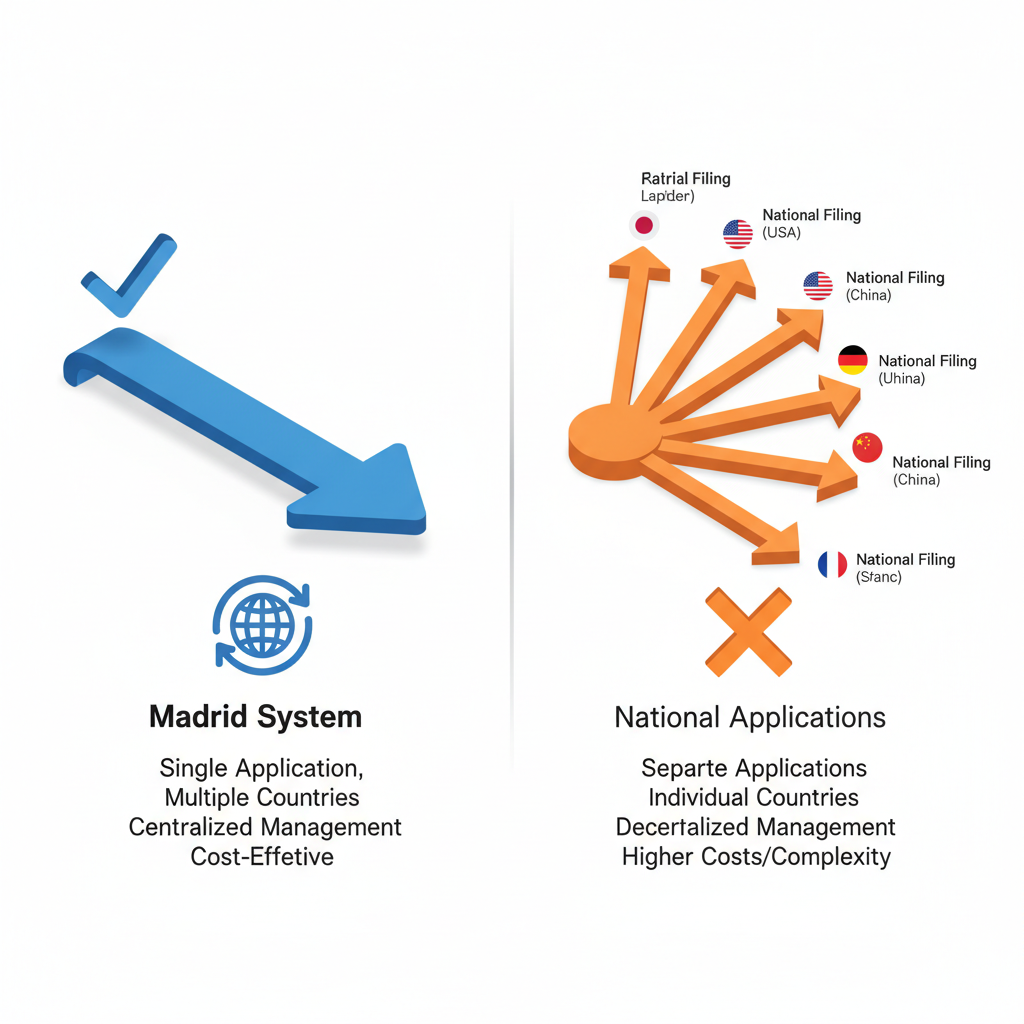
When scaling globally, the choice between the Madrid System and direct national filings is a strategic trade-off between administrative convenience and defensive robustness. The Madrid System, managed by WIPO, provides a centralized framework for extending protection through a single application, which is efficient for managing large portfolios. However, it is subject to the “central attack” rule: if your base registration fails or is narrowed during the first five years, all dependent international designations may be compromised [1]. For example, a company might use the Madrid System to quickly cover a broad range of countries, only to find that an opposition in their home country—perhaps due to a generic term in the base registration—inadvertently triggers a chain reaction that destabilizes their international protection.
| Feature | Madrid System (WIPO) | National Filings |
|---|---|---|
| Efficiency | Centralized, single-process management. | Fragmented; requires local representation. |
| Flexibility | Limited to the scope of the base mark. | High; allows jurisdiction-specific customization. |
| Legal Security | Vulnerable to the “central attack” rule. | Independent status per territory. |
In high-risk or hyper-competitive markets, direct national filings can provide a more stable defensive base. For instance, a brand entering a market with aggressive trademark squatting may find that independent national applications allow for more granular control over local specifications, which are less likely to be blocked by global administrative delays. Prioritizing a stable regional registration first often creates a defensible anchor before expanding into more volatile territories.
Strategic Prioritization of Target Markets
Choosing where to prioritize your Intellectual Property Protection & Registration efforts requires a disciplined look at your operational footprint. While the Madrid System offers broad coverage, your initial filings should mirror your most vulnerable or lucrative markets to ensure that your legal defensive layer keeps pace with your commercial growth.
- Revenue Concentration: Direct your primary resources to jurisdictions where the majority of your sales originate; these markets demand the highest level of legal certainty.
- Manufacturing and Supply Chain: Secure rights in countries where your products are produced or where your key distribution partners are located to prevent unauthorized third parties from controlling your supply flow.
- Piracy Risk Profiles: In sectors prone to high volumes of counterfeit goods, prioritize jurisdictions with robust enforcement mechanisms and active oversight to mitigate the risk of brand dilution.
- Digital Platform Saturation: If your model is heavily dependent on online marketplaces, focus your protection on regions where these platforms are most dominant and responsive to takedown requests.
By filtering your expansion path through these specific criteria, you move away from a scattergun approach and toward a targeted strategy that treats your rights as high-performance business assets rather than mere administrative records. Aligning your registration schedule with your specific revenue cycles ensures you are not over-extending your capital before your brand has secured a foothold in the local market.
Budgeting for Global IP Protection
Managing the financial lifecycle of your brand requires balancing immediate registration costs with the long-term need for defensive enforcement. You can save significantly on overall expenditures by utilizing streamlined procedures like Trademark registration in the EU compared to the cumulative expense of fragmented national filings across multiple borders.
Structuring Your IP Investment Timeline

Developing a strategic timeline is essential to align your IP budget with your commercial goals. Rather than adhering to an arbitrary schedule, professional practice dictates a flexible, risk-based approach tailored to your specific expansion plan. Before committing capital to filing fees, conduct a rigorous conflict check using tools like TMview to identify potential opposition risks. Next, refine your list of goods and services by utilizing the TMclass database to optimize for current and future business needs, minimizing the risk of procedural objections.
Consider the following checklist for a successful filing preparation:
- Clearance Search: Use TMview to assess existing conflicting marks.
- Classification Audit: Select appropriate classes via TMclass to avoid unnecessary fees.
- Risk Assessment: Evaluate potential opposition based on your target market’s legal landscape.
Staging your registrations according to revenue-generating milestones allows you to manage cash flow while maintaining security. When you time your filings to coincide with new market launches or product line releases, you ensure that legal maintenance remains a manageable overhead rather than a sudden liquidity drain. This approach aligns your defensive assets with your growth strategy. Once registered, adopt a proactive monitoring strategy—essential for identifying and addressing potential infringements early—rather than relying on reactive enforcement measures.
Hidden Costs of International Enforcement
Effective management of your intellectual assets requires looking beyond the initial filing phase. While establishing your presence is critical, the reality of global operations dictates that you must budget for the ongoing maintenance and defense of your portfolio. Consistent monitoring services are the backbone of any proactive strategy, allowing you to identify potentially infringing filings or unauthorized use of your branding on marketplaces before they escalate into full-scale disputes. For example, a common pitfall is failing to budget for opposition proceedings when a competitor files a confusingly similar trademark, which can cost significantly more than proactive monitoring.
| Action Phase | Strategy Type | Budget Focus |
|---|---|---|
| Portfolio Maintenance | Proactive | Renewal fees & address updates |
| Defensive Monitoring | Proactive | Watch services & market surveillance |
| Enforcement | Reactive | Legal fees & takedown actions |
These enforcement reserves are essential because, unlike the predictable costs of managing your intellectual property protection & registration portfolio, litigation or administrative challenges are reactive by nature. Allocating funds for active monitoring tools and professional oversight enables you to defend your brand’s integrity without disrupting your primary business operations. As your reach extends, understanding how these defensive costs fluctuate is the next logical step before we finalize your Borderless Brand Strategy.
Building a Borderless Brand Strategy
Scaling successfully requires transitioning from a local focus to a borderless strategy, where intellectual property acts as the foundational infrastructure for your international growth. By embedding proactive protection into your core business operations, you maintain the agility needed to compete in diverse digital markets. Effective long-term governance requires more than initial filings; it demands consistent, post-registration oversight to defend your market position. To evaluate the ROI of your assets, consider the following decision framework:
| Strategy Phase | Operational Focus |
|---|---|
| Portfolio Audit | Alignment with target EU markets per Nice Classification standards. |
| Defensive Monitoring | Proactive oversight and enforcement against unauthorized third-party use. |
| Market Expansion | Strategic filing for new goods and services as your catalog grows. |
For deeper insight into the complexities of maintaining your holdings, explore our guide on managing your IP portfolio.
Disclaimer: This content is for informational purposes only. Trademark eligibility and enforcement outcomes depend on specific jurisdictional laws and administrative decisions by the EUIPO.
For help with this task, use the Trademark registration in the EU service.
Frequently Asked Questions
How does EU trademark registration influence my ability to enforce rights on Amazon FBA and other marketplaces?
Securing a trademark through Trademark registration in the EU provides a vital legal foundation for brand protection programs on major e-commerce platforms. Marketplaces like Amazon rely heavily on official registration records to verify rights holders when processing infringement claims or brand registry applications.
- Brand Registry Access: A registered EU trademark is typically a prerequisite for accessing Amazon Brand Registry in Europe, which unlocks advanced listing control, A+ content, and protection tools.
- Counterfeit Mitigation: Official registration enables you to file formal takedown requests through internal platform portals, often resulting in faster resolution times than using generic legal threats.
- Proactive Monitoring: Registration allows you to actively police your brand across different EU member state storefronts, preventing unauthorized third-party sellers from diluting your brand identity.
What are the specific risks for drop shipping stores when filing for a trademark in the European Union?
Drop shipping businesses often face unique challenges because they may not directly control the product manufacturing or the underlying brand identity of the items they sell. When considering an EU trademark, you must first establish that you have the legal right to the brand name or logo being used.
Key considerations for drop shippers include:
- Ownership of Intellectual Property: Ensure your supplier agreement explicitly grants you the rights to the brand name, or that you are building your own unique private label brand to avoid trademark infringement claims.
- Geographic Scope: Since the EU operates under a single, unified trademark system, filing once protects your brand across all member states. This is cost-effective but requires a thorough clearance search to ensure your name isn’t already infringing on established brands in any of the 27 member countries.
- Regulatory Compliance: As the entity on record for the trademark, you assume legal responsibility for the goods sold under that brand, meaning you must ensure your suppliers meet EU product safety standards.
Does trademarking a podcast name in Europe offer protection across all media platforms?
Trademark protection is not blanket coverage; it is categorized by the Nice Classification system, which divides goods and services into specific classes. To effectively protect a podcast, you must align your registration with the relevant classes.
For podcasts, this generally involves:
- Class 41: Covering entertainment, production of radio and television programs, and podcast distribution.
- Class 38: Covering telecommunications and the transmission of digital media.
- Related Commercial Classes: If your podcast includes merchandise (like apparel or books), you must include those specific classes (e.g., Class 25 for clothing) in your application to prevent unauthorized use of your name on branded products.
Consulting with an expert ensures your application covers both your primary content distribution and potential future monetization streams.
What should clothing brands prioritize during the EU trademark registration process?
Clothing brands are high-risk targets for trademark infringement, making a clear defensive strategy essential. Beyond simply filing a word mark, apparel businesses should consider the following:
- Visual Representation: Consider registering both your brand name and your logo (a figurative mark) to maximize the scope of protection against design mimics.
- Comprehensive Search: The apparel industry is saturated. Before filing, perform a thorough search within the EUIPO database to avoid potential opposition from existing brands with similar sounding or looking marks.
- Class 25 Strategy: Be specific about the types of clothing covered in your Nice Classification application. If you expand your line from accessories to footwear or performance wear, ensure your registration reflects those additions to maintain full coverage.
What legal steps are required when licensing my brand to a distributor in the European market?
Licensing your brand is a powerful scaling tool, but it must be managed through a rigorous legal framework to prevent loss of control or brand dilution. Before signing a distribution agreement, you should have an active, registered EU trademark in place.
Essential components of a licensing agreement include:
- Quality Control Provisions: You must retain the legal right to inspect how your brand is being represented, including marketing materials and product presentation.
- Geographic and Duration Limits: Clearly define the territory (e.g., the entire EU or specific member states) and the term of the license.
- Registration Recording: In some jurisdictions, it is highly recommended to record the license agreement with the relevant IP office to ensure it is enforceable against third parties.
Always work with an IP attorney to draft these agreements to ensure your Trademark registration in the EU remains valid and protected while your distributor operates in the market.