Introduction: Protecting Your Startup’s IP in the EU
Scaling a business across European borders often exposes startups to immediate imitation risks that can derail market entry before the first growth milestone is reached. This guide explores how registering an EU trademark serves as the most effective legal foundation for securing your brand identity in all 27 member states simultaneously.
Core Pillars of Startup IP Security
Effective IP defense for growing companies requires a tiered approach that prioritizes brand recognition while managing technical assets. We will examine how trademark registration, patent strategy, and copyright frameworks create a comprehensive shield for your scaling operations.
Trademark Registration as Your Shield

In the competitive European landscape, a brand’s visual and phonetic identity is often its most vulnerable asset, especially for companies in the fashion, retail, and manufacturing sectors. The most reliable way to secure a brand in the EU is through formal registration, as it transforms a mere name or logo into an enforceable property right that spans the entire Union. Without this centralized protection, a startup may find its growth halted by pre-existing local marks in just one or two countries, leading to costly rebranding or litigation that consumes vital capital.
Strategic management of these assets provides an immediate return on investment by simplifying cross-border expansion. By securing a single registration at the EU Intellectual Property Office (EUIPO), businesses gain exclusive rights across all member states through one procedure and one set of rules. This is particularly critical for small businesses, as it eliminates the administrative burden of managing 27 individual national filings and provides a consistent standard of defense against replicas and marketplace infringements.
For international founders, including those looking to register a trademark in the EU as a US company, the process involves several technical checkpoints to ensure the mark is fully defensible:
- Pre-filing clearance: Utilizing tools like TMview to check for conflicting names or similar visual identities already active in European markets.
- Nice Classification accuracy: Correctly identifying classes of goods and services to ensure the scope of protection aligns with actual market usage.
- Distinctiveness assessment: Avoiding descriptive or technical terms that the EUIPO may reject during the examination phase.
A proactive filing strategy allows a company to react immediately to violations on digital platforms and marketplaces rather than spending months proving authorship. This legal clarity is essential for establishing trust with European distributors and partners who require proof of ownership before committing to long-term contracts. While brand identity serves as the primary shield, certain startups must also address the technical innovations and creative works that drive their unique market value.
For more information, see: Benefits of an EU trademark for small businesses.
Patents and Copyright Considerations
While securing a brand name is often the first priority, a holistic approach to protection requires looking beyond the logo to the technical and creative assets that drive a company’s valuation. For many founders, building a robust legal foundation involves a tiered strategy where trademarks coexist with patents and copyrights to create a multi-layered defense.
Patents in the European Union are reserved for technical inventions that are new, involve an inventive step, and have industrial applicability. Unlike the relatively straightforward trademark process, patenting requires disclosing the inner workings of your technology in exchange for a 20-year monopoly. For software-driven startups, this often presents a choice between patenting a specific technical process or relying on copyright and trade secrets. In the EU, computer programs “as such” are generally excluded from patentability, but inventions that provide a technical solution to a technical problem can still be protected. Determining whether your code meets this threshold is a high-stakes decision that dictates your long-term R&D security.
Copyright, conversely, arises automatically upon the creation of original works, including software code, database structures, and marketing content. While it does not require formal registration, relying solely on copyright can be limiting in commercial disputes, as it protects the internal expression rather than the external brand identity. To effectively manage these assets, startups should categorize them based on their functional role:
- Technical Assets (Patents): Unique hardware designs, chemical formulations, or industrial processes that offer a competitive advantage through functional innovation.
- Creative & Digital Assets (Copyright): Source code, user interface designs, instructional manuals, and high-quality photography used in e-commerce.
- Visual Identity (Industrial Designs): The specific shape of a product, such as a unique furniture silhouette or consumer electronics casing, which can be registered for EU-wide protection to prevent aesthetic clones.
A manufacturing startup, for example, might patent a new engine component while simultaneously registering its visual form as an industrial design to block competitors from selling look-alike parts. This ensures that even if a rival tries to circumvent the patent with a different internal mechanism, they cannot legally copy the product’s market-facing appearance.
Related topic reference: Register trademark in EU for US company.
Strategic Roadmap for EU IP Registration
Converting intellectual assets into enforceable rights requires a systematic approach to the European Union Intellectual Property Office. This roadmap examines the necessity of clearance searches and the administrative workflow for successful registration.
Conducting a Thorough Trademark Search
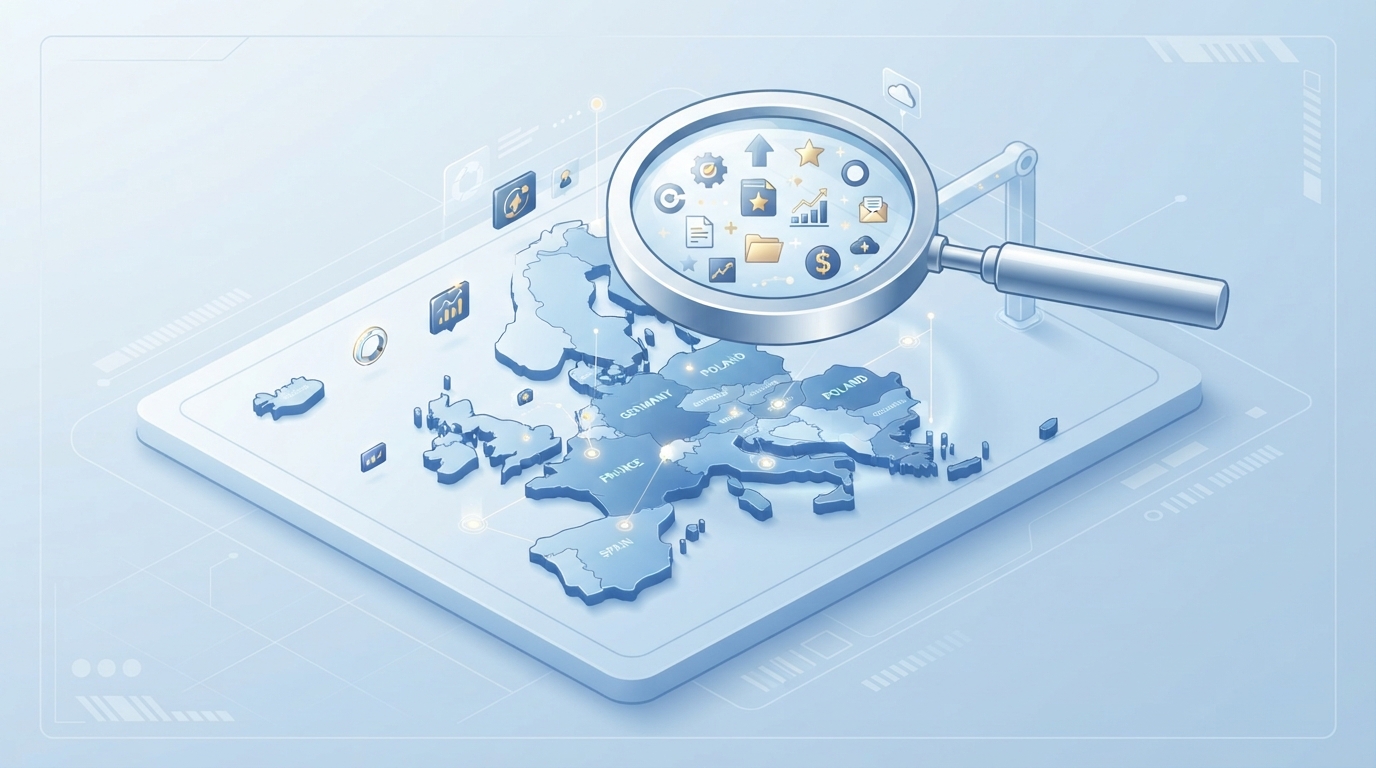
Launching a brand in the European market without a preliminary clearance search is a gamble that often results in expensive rebranding or immediate opposition proceedings. Building a robust foundation for your brand starts with ensuring your chosen name doesn’t infringe on the 27 member states’ existing rights. Because an EU trademark covers the entire territory, a single conflicting mark in any one country can block your entire application.
The most common mistake startups make is assuming a clear Google search or an available domain name equals a legally available trademark. Professional due diligence must include a phonetic, visual, and conceptual analysis across the EUIPO and national databases to identify “confusingly similar” marks. For example, under Article 8 of Regulation (EU) 2017/1001, an owner of an earlier mark can oppose your application if there is a likelihood of confusion, even if the marks are not identical, which often leads to ‘absolute grounds’ refusals that require expert legal intervention to navigate.
A thorough search strategy utilizes tools like TMview and eSearch plus to look for more than just identical matches. In European law, the likelihood of confusion is assessed based on the similarity of the signs and the similarity of the goods or services. For instance, a retail startup might find its application opposed by an established manufacturer if the names are phonetically close, even if they operate in different sectors. By identifying these risks early, you can adjust your naming strategy or negotiate a coexistence agreement before investing in packaging, marketing, and distribution networks. This proactive step is essential for any company planning to leverage trademarks for business growth across borders.
Once the search confirms a high probability of success, the focus shifts to the technical requirements of the filing itself to ensure the scope of protection is neither too narrow to be useful nor too broad to be defensible.
The EUIPO Registration Workflow
Once you have confirmed that your brand name does not infringe upon existing rights, you enter the formal administrative phase of the European Union Intellectual Property Office (EUIPO). This transition from research to filing is where strategic classification determines the scope of your legal protection. Treating the application as a precise boundary-setting exercise is essential, as the official EUIPO registration process requires a clear definition of goods and services according to the Nice Classification to secure exclusive rights.
The workflow follows a standardized path with strict procedural gates:
- Examination Phase: The office reviews the mark for “absolute grounds” of refusal, such as being purely descriptive or failing to distinguish your product under Article 7 of the European Union Trade Mark Regulation (EUTMR). Professional oversight at this stage is critical: for example, while a DIY applicant might simply list generic terms, an attorney identifies and narrows specific classes to proactively avoid Article 7 objections that frequently stall inexperienced filers.
- Publication and Opposition: Upon passing examination, your mark enters the EUTM Bulletin. This triggers a three-month window where third parties may file oppositions based on “relative grounds,” such as prior conflicting rights.
- Registration: If no successful oppositions occur, the mark is registered, granting unitary protection across all EU member states.
For growing businesses, this unified procedure replaces the inefficiency of 27 separate national filings. However, a common strategic error involves overly broad category selection, which increases the likelihood of accidental overlaps with existing marks and subsequent opposition. To avoid these procedural risks and ensure your filing withstands the scrutiny of investor due diligence, you may consider a professional trademark registration service. Expert oversight during the drafting phase transforms your brand from a vulnerable concept into a defensible corporate asset.
Note: Official outcomes and timelines depend on individual mark characteristics and potential third-party actions; this summary is for informational purposes and does not constitute formal legal advice.
Common IP Mistakes Startups Make
Even with a clear registration roadmap, many startups face critical setbacks by neglecting long-term scalability and timing. We will examine how ignoring geographical expansion and delaying filings creates unnecessary risks for growing brands.
Ignoring Geographical Expansion Needs

A frequent error among emerging companies is viewing their brand protection through a purely local lens. While current operations might be confined to a single country, the digital nature of modern commerce means a brand is often visible across borders from day one. Failing to align an expansion plan with legal safeguards often leads to a situation where a company is legally “locked out” of a neighboring market. Under the “first-to-file” principle—the foundational doctrine established by the European Union Intellectual Property Office (EUIPO)—the party that files first generally holds the rights, regardless of who used the name first elsewhere.
Consider a retail scenario: a startup launches a line in a single EU member state, neglecting broader registration to save costs. Two years later, they attempt to scale into France and Germany, only to find a competitor has already registered a confusingly similar mark via a centralized EUTM application. The startup is then forced to either rebrand, negotiate a costly coexistence agreement, or abandon the new market. This risk is compounded by the fact that many third-party marketplaces and digital platforms require proof of registration to grant access to brand protection tools, which are essential for managing global counterfeit risks.
To mitigate these expansion risks, startups should evaluate their requirements based on growth criteria, including potential market overlap, intended digital distribution channels, and future investor due diligence, which often marks a lack of cross-border protection as a significant valuation liability. Securing a trademark registration in the EU before scaling is generally more cost-effective than litigating a conflict after the brand has built local equity.
Delayed Protection and Copycat Threats
When a startup focuses solely on its immediate local surroundings, it inadvertently leaves its most valuable assets vulnerable to sophisticated copycats who monitor emerging market trends. Delaying the filing process creates a dangerous window of opportunity for competitors to occupy the legal space you intended to claim, effectively locking your brand out of neighboring jurisdictions before you even begin your expansion.
Waiting until you reach a certain revenue milestone or secure a Series A round is often too late, as the cost of reclaiming a stolen identity or rebranding across the continent far outweighs the initial investment in protection. In highly competitive sectors like retail and e-commerce, lookalike branding and logo imitation can appear within weeks of a successful digital launch, making a proactive approach the best way to protect intellectual property in the EU. If a competitor registers a similar name in a key market like Germany or France while you are still “testing the waters” elsewhere, you may face expensive opposition proceedings or be forced to negotiate a lopsided licensing deal just to enter those territories.
The risks of procrastination extend beyond simple brand theft to fundamental business operations, including:
- Contractual Obstacles: Many European distributors and retail chains refuse to sign long-term agreements unless the brand is legally secured, as they do not want to inherit the risk of third-party infringement claims.
- Marketplace Enforcement: Without a registered trademark, removing counterfeiters or copycats from digital platforms like Amazon or Allegro becomes an uphill battle with no guarantee of success.
- Diluted Distinctiveness: If multiple “inspired” brands emerge simultaneously, your original mark may lose its ability to function as a unique source identifier in the eyes of the EUIPO, weakening your legal standing.
By securing your rights early, you transform your branding from a vulnerable idea into a concrete corporate asset that can be defended, licensed, or used as collateral for financing.
For help with this task, use the Trademark registration in the EU service.
Securing Your Intellectual Assets Today
Viewing intellectual property as a strategic investment rather than a mere administrative burden is the best way to protect intellectual property in the EU for any scaling enterprise. By securing your assets early, you transform legal risks into tangible value that attracts investors and simplifies market entry across all 27 member states. To maximize your growth potential, consider the benefits of an EU trademark for small businesses and consult a specialized attorney to ensure your filing strategy aligns with your long-term commercial goals.
Frequently Asked Questions
What is the fundamental difference between an EU trademark and an international trademark via WIPO?
An EU trademark (EUTM) provides you with a single, unitary registration that grants protection across all 27 member states of the European Union through one application filed with the European Union Intellectual Property Office (EUIPO). In contrast, the Madrid System, managed by the World Intellectual Property Organization (WIPO), is a centralized filing system that allows you to designate individual countries or regions for protection.
Key distinctions include:
- Scope: The EUTM covers the entire EU territory automatically. WIPO acts as a hub to send applications to specific national offices (like the USPTO for the US or the Japan Patent Office).
- Flexibility: If you only need protection in one or two countries outside the EU, the WIPO system is often more cost-effective. However, for startups planning to scale across Europe, the EUTM is generally faster and more efficient than filing in 27 separate jurisdictions.
- Dependency: A WIPO international registration is often dependent on a ‘basic mark’ from your home country for the first five years. The EUTM is an independent asset from the moment of registration.
How does Brexit impact EU trademark protection for my brand?
Since the United Kingdom officially left the EU, the EUIPO no longer holds jurisdiction over the UK. Consequently, an EU trademark registered after the transition period does not grant protection in the United Kingdom.
For startups, this means:
- Separate Filings: You must now register your trademark with the Intellectual Property Office (UKIPO) in addition to the EUIPO to secure your brand identity in the British market.
- Portfolio Review: If you held an EUTM prior to Brexit, the EUIPO automatically created a comparable UK trademark. However, new applicants must treat the UK and the EU as two distinct legal territories requiring separate applications and potential search strategies.
Why is hiring a specialized EU trademark lawyer essential for SMBs?
While it is possible to file a trademark application directly with the EUIPO, small and medium-sized businesses (SMBs) often lack the legal infrastructure to navigate complex regulatory hurdles. An experienced EU trademark attorney provides more than just administrative assistance; they perform a critical strategic function by:
- Mitigating Opposition Risks: A lawyer conducts a comprehensive conflict search that goes beyond simple database keyword matching to identify ‘likelihood of confusion’ with existing brands.
- Navigating Refusals: If your mark faces an objection based on absolute grounds (like lack of distinctiveness), a lawyer can draft legal arguments to convince examiners that your brand deserves registration.
- Long-term Strategy: They help align your trademark classification (Nice Classification) with your long-term business goals, ensuring you aren’t paying for protection you don’t need while ensuring you are fully covered in future markets.
Can a US-based company register a trademark in the EU without a local presence?
Yes, a US-based company can register a trademark in the EU. There is no requirement for the applicant to have a physical office, warehouse, or residency within the European Union to own an EU trademark.
However, there is a technical caveat: if you do not have a real and effective industrial or commercial establishment within the European Economic Area (EEA), the EUIPO may require you to be represented by a professional representative (an attorney or agent) for all proceedings before the office. Engaging a legal expert is not just a strategic advantage; for non-EU entities, it is often a mandatory administrative step to ensure your application remains compliant with EUIPO rules.
What is involved in finding a trademark attorney in cities like Madrid?
When seeking local counsel in major business hubs like Madrid, focus on professionals who are authorized to represent clients before the EUIPO. While national IP offices handle local filings, an attorney capable of managing EU-wide strategy is better suited for a growing startup.
To verify the right professional, check for:
- EUIPO Representation: Ensure they are on the official list of authorized professional representatives.
- Specialization in Startups: Look for firms that understand the ‘lean’ requirements of startups versus the heavy litigation needs of global corporations.
- Language and Jurisdictional Expertise: If your primary target market is Spain, a local attorney provides the benefit of handling potential national-level disputes while maintaining a bird’s-eye view of your broader EU IP strategy.
How do I know if my brand name is available before I begin the application?
Before spending time and capital on an application, you must conduct a professional trademark search. You can start with the EUIPO eSearch database, but keep in mind that a ‘search’ is not limited to an exact spelling match.
A proper search should cover:
- Phonetic Similarity: Does your brand name sound like an existing registered mark?
- Conceptual Similarity: Does your logo or name convey the same meaning or message as an existing mark in the same industry?
- Nice Classification overlap: Are there brands in your specific class of goods or services that could block your registration?
Using only public search tools often results in ‘false negatives.’ For high-stakes branding, a full availability report provided by an IP attorney can reveal unregistered prior rights or ‘common law’ uses that could lead to an expensive opposition later down the line.