Introduction: Understanding the Post-Brexit IP Divide
Since the Brexit transition ended, an EU trademark no longer provides protection within the United Kingdom, forcing businesses to navigate two distinct legal frameworks. This article explores the administrative and strategic shifts required when managing portfolios across the EUIPO and UKIPO.
The Territorial Shift: EU vs UK
Understanding the divergence between European and British intellectual property regimes is now a prerequisite for any cross-border commercial strategy. We will examine the specific jurisdictional limits of the EUIPO and the resulting independent filing obligations for UK-bound brands.
Jurisdictional Limits of EUTM
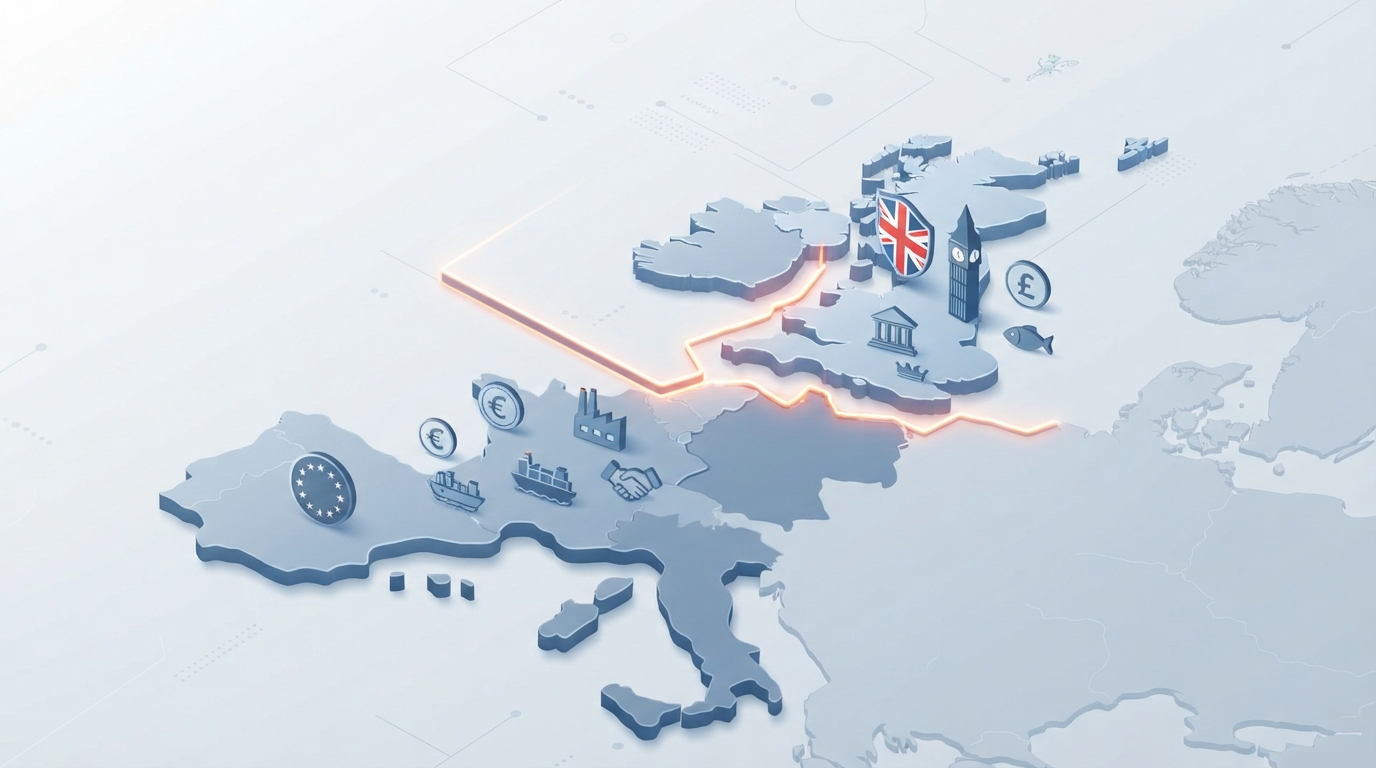
The post-Brexit reality dictates that the European Union Trade Mark (EUTM) has lost its unitary effect over the British Isles. While a single application at the European Union Intellectual Property Office (EUIPO) remains efficient for securing exclusive rights across the 27 Member States, this protection stops strictly at the borders of the EU bloc. For companies accustomed to the pre-2021 system, the primary risk is the “territorial trap”—assuming a European registration covers the UK, only to leave intellectual property vulnerable to local squatters.
| Feature | EUTM | UK Trademark |
|---|---|---|
| Territorial Reach | 27 EU Member States | United Kingdom |
| Legal Basis | Regulation (EU) 2017/1001 | UK Trade Marks Act 1994 |
| Market Size | ~450 million consumers | ~67 million consumers |
Because these systems operate independently, a successful registration in the EU does not grant automatic entry into the UK register. Each office conducts an independent examination; for instance, a term deemed descriptive in English may face stricter scrutiny in the UK than within the EU’s linguistically diverse landscape. Applicants should note that a UK-based address for service is required for proceedings before the UK Intellectual Property Office.
Strategic applicants often compare European and international filing routes to determine the most cost-effective approach for these split jurisdictions. Relying solely on the EUIPO for a brand with significant UK revenue is a gamble that may necessitate a total rebrand or costly litigation. Establishing a dual-track filing strategy ensures robust protection on both sides of the English Channel.
Related topic reference: eu trademark lawyer for smbs.
Independent Filing Obligations
Establishing a brand in the post-transition landscape requires moving beyond the convenience of a single application. While the EUIPO offers a streamlined path for 27 Member States, the UK intellectual property office operates as a completely separate legal entity with its own procedural requirements and examination standards. For any business aiming to maintain a footprint in both London and Paris, dual-filing is no longer an optional strategy—it is the baseline requirement for adequate asset protection.
Navigating the difference between European trademark and WIPO systems or direct national filings involves understanding that the UK authority does not grant any automatic priority or recognition based solely on an EU filing. Each office conducts its own independent search for conflicting marks and applies its own local laws, such as the UK Trade Marks Act 1994. This independence means that a mark accepted in Alicante might still face a refusal in Newport due to different interpretations of descriptiveness or distinctiveness in the English language. For instance, a term deemed generic in a descriptive sense under UK law may still hold distinctiveness in other European jurisdictions.
To successfully navigate these independent obligations, an applicant must satisfy three specific prerequisites for each office:
- Distinct Legal Representation: Professional representation is often required for non-resident applicants; specifically, the UK authority mandates an address for service within the UK, Gibraltar, or the Channel Islands for new applications.
- Independent Classification Alignment: Although both offices use the Nice Classification, the UK office is often more prescriptive regarding the specific terms used to describe services. Applicants should consult official classification tools to ensure their specification meets local standards and avoids formal deficiencies.
- Separate Fee Structures: Filing fees must be paid directly to each respective office in their local currency, as there is no mechanism to offset costs between the two jurisdictions.
Failing to account for these nuances often leads to protection gaps that competitors can exploit. Managing these parallel tracks effectively depends on a structured administrative approach to ensure no deadlines are missed across the different registries.
Related topic reference: Difference between European trademark and WIPO systems.
Managing Dual Filing Requirements Efficiently
Managing the administrative burden of filing with both the Manufacturer and UKIPO requires a shift from viewing these as a single block to treating them as distinct, independent legal exercises. Since the post-Brexit landscape removes the possibility of a single, all-encompassing filing, applicants must coordinate their strategy to ensure protection across both regions aligns with their operational priorities. For those navigating the complexities of securing rights in both markets, professional guidance regarding trademark registration in the EU can help mitigate risks like conflicting applications or improper classification of goods and services.
To maintain efficiency, categorize your filing by the core operational strength of the brand; UKIPO examination standards often differ from Brand in their interpretation of descriptiveness, particularly regarding English-language terms. Rather than attempting a synchronized submission that ignores these jurisdictional nuances, prioritize the jurisdiction where your immediate commercial presence is strongest. This allows for a more controlled approach to responding to potential office actions or opposition proceedings, which are handled separately by each registry. Always consult official resources such as the EUIPO and UKIPO websites to verify the latest filing requirements, as legislative updates can impact procedural compliance.
A Four-Week Filing Preparation Timeline

A successful dual-filing strategy requires managing the distinct procedural requirements of the EU and UK offices, as post-Brexit regulations mean that a filing in one jurisdiction offers no automatic legal priority or simplified access in the other. To navigate these independent registration pathways, we recommend a proactive four-week preparation workflow:
| Timeline | Focus Area | Key Action |
|---|---|---|
| Week 1 | Conflict Clearance | Perform consolidated searches via official databases to detect potential oppositions. |
| Week 2 | Term Scoping | Audit classifications; verify that terms are sufficiently narrow to pass rigorous scrutiny for descriptiveness. Use professional classification tools to ensure accuracy. |
| Week 3 | Logistics Alignment | Assess if your supply chain (e.g., local warehousing) creates specific local risks, adjusting your filing to secure priority in high-value territories. |
| Week 4 | Compliance Review | Ensure all data—especially the requirement for a local address for service—is finalized before proceeding with the application. |
Common Pitfall: A typical error is applying a “blanket filing” approach. For instance, broad definitions acceptable in multi-lingual EU filings are often flagged by UK examiners as being too vague, leading to expensive post-filing amendments. By resolving these discrepancies during the preparation phase, applicants avoid unnecessary administrative delays.
Disclaimer: This information is for educational purposes and is not a substitute for professional legal advice. Filing outcomes remain subject to examiner discretion and the specific regulatory landscape of each office.
Avoiding Common Filing Pitfalls
Procedural divergence between these intellectual property offices often leads to unexpected refusals if filings are treated as identical. While the European Union’s agency typically accepts broader descriptions of goods and services, the British counterpart applies more stringent scrutiny to the clarity and specificity of terms. Successfully securing a trademark requires a bifurcated strategy that reconciles these differing jurisdictional standards to avoid costly office actions.
Warning: The Classification Gap
The British office maintains a proprietary database that often flags general terms accepted in the EU. To mitigate risk, adopt a “specificity-first” approach:
- Avoid broad terms: Replace vague descriptions like “software” (Class 9) with precise identifiers.
- Use granular detail: Instead of “software,” specify “downloadable software for processing financial transactions.”
- Cross-reference: Consult the official classification guidance to ensure term alignment across regions.
Furthermore, because these systems operate independently, an opposition or challenge in one territory does not automatically impact the other. A robust portfolio strategy involves monitoring both databases, as legal defense in one region does not grant immunity against challenges filed in the other.
Strategic Considerations for SMEs
Entering the post-Brexit landscape requires small and medium-sized enterprises to move beyond administrative compliance and adopt a rigorous economic mindset regarding their intellectual property. This section explores the financial logic behind choosing dual registration and how to align these legal costs with specific market entry milestones to ensure sustainable brand growth.
Cost-Benefit of Dual Protection

When assessing the economic viability of protecting a brand, many business owners view intellectual property registration as a sunk cost rather than a defensive asset. In the context of lineup vs ukipo dynamics, the true value of dual protection lies in preventing market foreclosure. Without registered rights in both territories, a competitor can legally occupy your brand’s space in one jurisdiction while you are building a reputation in the other, effectively holding your future expansion hostage.
“In the current IP environment, a trademark is not just a certificate; it is a proprietary barrier to entry. For an SME, the cost of dual registration is significantly lower than the cost of a rebranding exercise or a multi-year litigation battle caused by a local squatter in a territory where the brand was left unprotected.”
To justify the budget for independent filings, we advise our clients to evaluate the ROI through the lens of asset valuation. A registered trademark increases the book value of a company during funding rounds or acquisitions. If a business generates significant revenue from both UK and EU consumers, the combined filing fees represent a negligible percentage of the annual turnover compared to the risk of losing the exclusive right to use the brand name. The decision-making process should prioritize jurisdictions where the commercial footprint is largest, a concept further detailed in our analysis of international filing strategies for small businesses. This economic framework provides the necessary data to determine where to focus resources first when prioritizing market entry strategy.
Prioritizing Market Entry Strategy
Effective brand management requires moving beyond basic cost-benefit analysis to a strategy that synchronizes with your commercial expansion. Aligning filing decisions with sales growth milestones ensures that capital is deployed where it generates the most immediate legal leverage. Instead of a reactive approach, consider this phased roadmap:
- Phase 1: Initial Market Entry. Focus on the territory where primary revenue is generated (e.g., EU-wide coverage for the 27 member states).
- Phase 2: Logistical Support. Secure local registration if warehousing, manufacturing, or fulfillment operations are established in specific jurisdictions, even if direct sales are secondary.
- Phase 3: Scalable Growth. Monitor the EUIPO database for potential conflicts and defer additional filing costs until the pre-launch phase of new products.
When evaluating the need to manage trademark filings across these regions, the decision hinges on your immediate revenue-generating territories and supply chain logistics. For an American company or non-EU entity, the initial focus often centers on the 27 member states. However, if your logistics hub or e-commerce platform specifically targets British consumers, the jurisdictional divergence becomes a high-priority risk. For example, a common mistake is assuming that an existing EU registration automatically covers the UK post-Brexit; businesses failing to secure independent local rights often face significant customs delays or infringement challenges when moving goods across the channel.
In practice, prioritize markets based on operational dependency to mitigate market foreclosure. High-value assets may benefit from the specific, granular classification standards of the local intellectual property office, which can differ from broader regional registrations. By mapping your intellectual property strategy to these commercial realities, you ensure that your brand remains a scalable asset while avoiding the risks associated with jurisdictional gaps and local infringement.
Secure Your Brand Across Borders
Since the end of the transition period on December 31, 2020, the divergence in registration processes means that a centralized filing no longer suffices for comprehensive protection. As confirmed by UK Government guidance, EU trademarks (EUTMs) do not extend to the UK, necessitating a parallel filing strategy to avoid coverage gaps.
To mitigate the risk of market foreclosure, brands should evaluate their commercial footprint rather than relying on blanket filings. Consider this decision framework before finalizing your strategy:
| Factor | Action |
|---|---|
| Supply Chain | File locally if you have UK warehousing or manufacturing. |
| Brand Expansion | Monitor relevant databases for conflicting marks while deferring costs until the pre-launch phase. |
| Legal Representation | Appoint a local agent for post-Brexit matters; former representatives may lack standing in these jurisdictions. |
Securing your brand across borders requires precise coordination. If you are ready to formalize your protection, you can book a consultation for our trademark registration service to ensure your strategy is fully aligned with current regulations. For further insight into how these procedural shifts impact SMEs specifically, our previous section on strategic navigation details the necessary legal considerations for smaller portfolios.
For help with this task, use the Trademark registration in the EU service.
Frequently Asked Questions
What is the difference between an EU trademark and a WIPO international registration?
While both systems aim to simplify the protection of intellectual property, they serve different functions. An EU Trademark (EUTM), managed by the EUIPO, is a unitary right that grants protection automatically across all 27 EU member states through a single application and registration process.
A WIPO (World Intellectual Property Organization) registration, often referred to as an International Registration under the Madrid System, is not a single global trademark. Instead, it is a centralized procedure that allows a brand owner to designate multiple individual countries (or regions like the EU) in one application. Key differences include:
- Base requirement: To use the WIPO system, you must first have a home registration or application (the ‘basic mark’) in your country of origin. An EUTM has no such requirement.
- Flexibility: WIPO allows you to ‘pick and choose’ specific countries (e.g., USA, UK, China, and the EU) whereas an EUTM is an all-or-nothing package for the entire EU bloc.
- Dependencies: An international registration remains dependent on the basic mark for the first five years; if the basic mark fails, the international registration may be affected.
Why would a US-based company need to register a trademark in the EU?
For a US company, the EU market represents one of the largest single consumer bases in the world, totaling approximately 450 million people. Registering a trademark through the EUIPO is critical for the following reasons:
- Unified Enforcement: It provides a single legal weapon to stop infringing activities in all 27 EU countries, rather than having to litigate in each member state individually.
- Asset Valuation: A registered EU trademark is a tangible asset that increases company valuation, which is particularly important for US startups seeking venture capital or preparing for an exit.
- Market Entry Control: It prevents ‘trademark squatting,’ where third parties register your brand name first, essentially holding your entry into the European market hostage.
US companies should prioritize Trademark registration in the EU early in their expansion strategy to ensure their brand identity is legally secure before launching marketing campaigns or logistics operations in Europe.
How does the ‘Address for Service’ requirement work for the UKIPO?
Since the conclusion of the Brexit transition period, the UKIPO has strictly enforced a local address for service requirement. If you are a foreign entity—including an EU-based company—you cannot simply list your own foreign address on a new UK trademark application.
To successfully file, you must provide an address in the UK, Gibraltar, or the Channel Islands. This is typically managed by appointing a UK-qualified trademark attorney or legal representative. This agent acts as the official point of contact for the UKIPO, ensuring that all correspondence, deadline notifications, and potential opposition documents are received and addressed in accordance with UK law.
What are the benefits of hiring a specialized EU trademark attorney for an SME?
Small and Medium-sized Enterprises (SMEs) often have limited budgets and cannot afford the risks associated with a rejected trademark application. A specialized attorney provides value beyond simple filing by:
- Performing comprehensive clearance searches: Many SMEs skip this step, but professional searches identify ‘hidden’ conflicts that are not immediately obvious in public databases.
- Optimizing classification: Drafting the list of goods and services is a strategic task. An expert knows how to draft descriptions that are broad enough to cover future business expansion but narrow enough to avoid ‘scope’ objections from examiners.
- Strategic Filing Advice: An attorney can advise on whether to file in the EU, the UK, or both, based on your specific growth milestones, preventing unnecessary expenditure on jurisdictions where you have no immediate commercial activity.
How do I find a trademark attorney in Madrid or other EU hubs?
Finding the right legal partner in Europe involves looking for professionals experienced with the EUIPO, which is headquartered in Alicante, Spain. While you are not required to hire an attorney based specifically in the city of the IP office, working with a firm that has a deep understanding of EU-wide trademark law is essential.
When searching for counsel:
- Verify credentials: Ensure the attorney is a qualified representative authorized to act before the EUIPO.
- Look for ‘Legal Entrepreneurship’ experience: Choose practitioners who understand the business context of an SME, not just the legal theory.
- Check for cross-border expertise: Because your business operates internationally, your attorney should be familiar with the interplay between EU regulations and the national laws of individual member states, as well as the nuances of post-Brexit UK law.